Trademark Registration in Pakistan: Why Businesses Wait Too Long

Most businesses build the name first and think about protecting it later. They design a logo, print packaging, launch a website, grow a following and only then wonder whether anyone else already owns that name. By that point, fixing the problem is a lot more expensive than preventing it. Good legal consultancy services exist precisely for this gap: spotting the risk before the money’s already spent, not after.
Here’s the thing people miss. Registering a company with SECP doesn’t protect your brand. Neither does owning the domain. Trademark protection is a separate, deliberate step and the businesses that skip it usually don’t find out until a rebrand is already on the table.
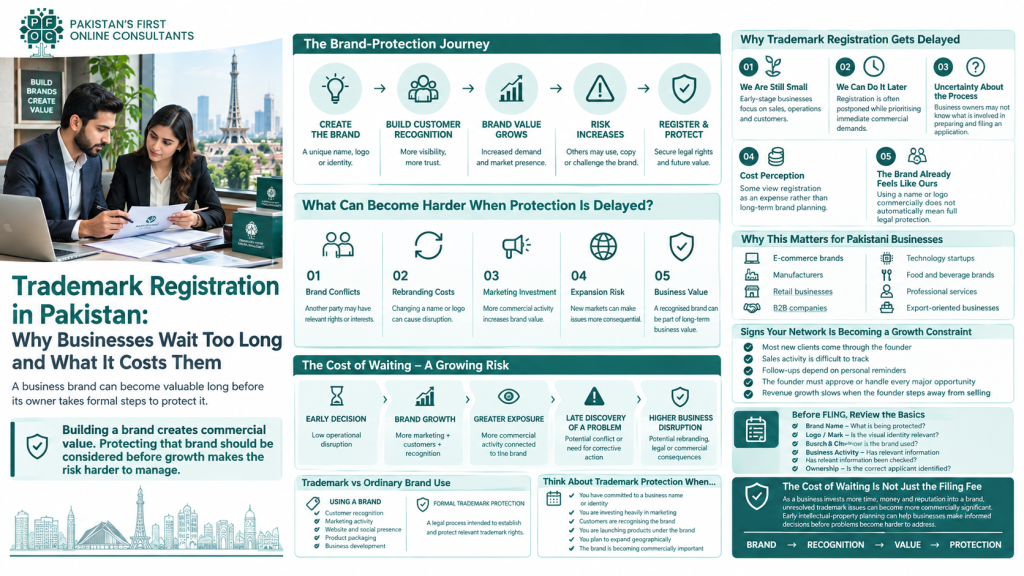
Why Do Businesses Wait?
Ask any small business owner why they haven’t registered their trademark, and you’ll hear some version of the same five excuses.
“We’re still small.” Size has nothing to do with whether a name is worth protecting. It’s about whether you plan to keep using it.
“I’ve used this name for years.” Years of use feels like ownership. Legally, it isn’t the same thing, and treating it as equivalent is where trouble starts.
“My company’s already registered with SECP.” This is the big one. SECP registration confirms your company exists as a legal entity. It says nothing about whether you’re allowed to use that name commercially, or whether someone else already has rights to something similar.
“I’ll register once we’re successful.” Success is exactly when the risk gets expensive. The more you’ve spent on packaging, ads, and customer recognition, the more you stand to lose if a conflict surfaces.
“Registration costs too much.” Maybe. But compare that cost to reprinting every label, rebuilding a website, and starting your marketing from zero. Delay doesn’t eliminate cost.it just moves it somewhere bigger.
What Delay Actually Costs You?
Say a clothing brand launches, prints thousands of labels, and spends heavily on ads for a year. Then someone flags a conflicting trademark. Now what? The labels are junk. The website needs new branding. Every social post, every piece of customer recognition built up over that year gone or badly compromised.
That’s not a worst-case scenario. It’s a predictable outcome of skipping a search that takes days, not months.
Disputes eat time too, not just money. Legal costs, management hours spent sorting it out, delayed expansion into new cities or products because the brand itself is suddenly in question none of that shows up on the original registration-fee spreadsheet, but it’s real.
SECP, Domains, and Social Media Don’t Protect Your Brand
SECP company registration confirms your business exists as a legal entity. A domain name confirms you control that web address. Social media accounts confirm you hold those handles. None of these confirm your own rights to the brand itself; only trademark registration does that.
“I registered the company, bought the domain, and I’ve used the name for years nobody can touch it” is one of the most common assumptions in Pakistani SMEs, and one of the riskiest.
What to Check Before Your File?
Before spending another rupee on branding, run through this:
- Search first. Look beyond the exact spelling check for similar names too. A Google search isn’t a trademark search; they’re not the same exercise.
- Check distinctiveness. Generic or purely descriptive names are harder to protect than something distinctive.
- Decide what needs protecting the name, the logo, a slogan, or all three.
- Get the class right. Trademark classes correspond to specific goods and services. File under the wrong one, and your protection doesn’t cover what you actually sell.
- Confirm ownership details. Individual or company, correct name, consistent details across documents. Small errors here cause real delays.
Name, Logo, or Both?
If the word itself carries commercial weight the way people say it, search it, recognise it, register the name. If your visual identity does the heavy lifting, register the logo. Many businesses need both, and one application rarely covers everything automatically. Decide this deliberately, not as an afterthought.
How Registration Actually Works?
The process runs in stages: search, choose your class, prepare and file the application, then wait for examination. Filing is not registration that distinction trips up more business owners than almost anything else in this process. After examination comes possible objections, then publication, then an opposition window where third parties can challenge your application, and finally, registration itself. After that, renewal keeps protection alive; it isn’t a one-time task.
There’s no single guaranteed timeline. Objections extend it. Opposition extends it further. Plan around the process, not around a fixed date.
Objection Isn’t Rejection
An objection from the Registry during examination doesn’t mean your application is dead. It means something needs addressing often distinctiveness or similarity to an existing mark and you respond within the given deadline. Ignore it, though, and the deadline becomes real.
Opposition is different: a third party challenges your application during the public window, rather than the Registry raising a concern itself. Objection and opposition often get confused, but neither one equals automatic failure.
If Someone’s Already Using a Similar Name
Don’t assume infringement the moment you spot a similar brand. Check whether it’s registered, who owns it, when they filed, and how much overlap actually exists between your goods and theirs. Branded Merchandise Order Platforms Keep your own records, invoices, ads, packaging, sales data because if a dispute does happen, evidence of your use matters.
Registration Cost vs the Cost of Doing Nothing
Registration costs include official filing fees, professional fees, response costs if objected, and renewal fees. The cost of delay looks different: rebranding and reprinting, rebuilding digital assets, lost marketing spend, legal costs, and disrupted expansion.
The real question isn’t “how much does registration cost.” It’s “what happens if I find out about a brand conflict after I’ve already built the business around it?”
Common Mistakes
Registering the company but never the trademark. Waiting for success first. Searching only on Google. Spending heavily before checking availability. Choosing the wrong class. Assuming filing equals registration. Ignoring an objection. Confusing objection with opposition. Forgetting renewal entirely. These aren’t rare mistakes; they’re the default path for most SMEs that skip proper legal consultancy services early on.
When to Get Professional Help?
Bring in help when a similar mark already exists, when the right class isn’t obvious, when you’ve received an objection or opposition, or when you’re weighing a serious rebrand. A second set of experienced eyes tends to catch what you’re too close to see yourself.
FAQs
Does registering my company with SECP also protect my brand name?
No, the two are separate processes entirely. SECP registration confirms your company exists as a legal entity, nothing more. Trademark registration is the only step that actually protects your brand name from being used by someone else.
Is filing a trademark application the same as being registered?
Not at all, and this mix-up causes real problems for business owners. Filing simply starts the process; examination, possible objection, and an opposition window all come after. Only once your application clears every stage does actual registration happen.
What should I do if my trademark application receives an objection?
Read the specific grounds carefully rather than panicking, since an objection isn’t a rejection. Check the response deadline and prepare your reply within that window. For anything beyond a straightforward issue, professional help is worth bringing in.
Can someone else register a name I’ve already been using for years?
It’s possible, because prior use alone doesn’t guarantee legal protection in every case. Your years of use may matter in a dispute, but it isn’t a substitute for actual registration. That’s exactly why checking your position early makes sense.
Should I register my brand name, my logo, or both?
It depends on where the commercial value actually sits in your brand. If people recognise the word itself, register the name; if the visual identity carries more weight, register the logo. Many growing businesses end up needing both.
The Bottom Line
Protecting a brand early costs far less than fixing one later. Search before you spend. Get the class right. Understand that filing and registration aren’t the same thing. Take objections seriously, keep your records, and don’t assume SECP or a domain name is doing a job it was never built for.
A trademark decision made early helps you understand your brand’s risk before that risk becomes expensive to fix. That’s the kind of groundwork PFOC (Pakistan’s First Online Consultants) helps businesses lay, so brand decisions get made with evidence, not guesswork.